Bringing First-Class SGLang Serving to llm-d





In Serving GLM-5.2 for Agentic Workloads on llm-d, we showed how llm-d serves long-context coding agents on NVIDIA H200 GPUs with vLLM—combining disaggregated prefill and decode pools, wide expert parallelism, prefix- and load-aware routing, and tiered KV caching. Since then, contributors from the llm-d and SGLang communities have made SGLang a first-class, Kubernetes-native inference engine in llm-d's GLM-5.2 well-lit path, the project's tested reference deployment. We also measured SGLang's multi-tier KV cache on single-replica and multi-replica clusters. This post tells that story in three parts:
- Engine-agnostic
llm-darchitecture: howllm-ddecouples Kubernetes workload orchestration, prefix-affinity routing, and disaggregated serving from individual model servers so vLLM and SGLang share a common operational model. - First-class SGLang integration: how the SGLang and
llm-dcommunities adapted SGLang's Wide-EP runtime to work natively withllm-d's Kubernetes routing and disaggregated serving. - Tiered KV-cache offloading: how pairing SGLang's hierarchical KV cache with
llm-d's prefix-aware routing and Kubernetes failover keeps long agent sessions cached across host RAM and shared storage—surviving high concurrency, pod evictions, and cold restarts.
TL;DR — What We Enabled and What Operators Can Expect
-
One
llm-dplatform across engines:llm-dusers can choose SGLang as their serving engine backend alongside vLLM. By swapping only the engine-specific deployment overlay and router configuration, SGLang runs on the sameDisaggregatedSetorchestration, per-rankInferencePooldiscovery, prefix-cache-aware routing, and verification workflow. -
Kubernetes-native SGLang Wide-EP: In Wide-EP deployments, each attention data-parallel (
DP) rank holds its own KV cache while sharing expert weights across GPUs. To letllm-droute requests to the rank holding a warm prefix, we worked with the SGLang community so every DP rank acts as an independent, routable, and observable Kubernetes endpoint—even across multi-node prefill and decode pools. -
Host RAM (
L2) eliminates theL1thrashing cliff: On a 16-GPU1P1Ddeployment, offloading evicted KV blocks to host RAM keeps cache hit rates at85%–95%, raises concurrency-128output3.94xfrom319to1,257 tok/s, and cuts median TTFT from174.2 sto20.1 s. -
Multi-replica scale-out and
Shared L3resilience: Scaling to32H200 GPUs across two prefill replicas and a 2-node decode pool cuts concurrency-128median TTFT5.9xfrom20.1 sto3.43 sat1,903 tok/soutput. AddingShared L3restores evicted sessions on the surviving replica during live pod failover—loading1.08Mtokens at a99.94%hit rate and cutting survivor queue recovery time in half—and cuts cold-replica recovery TTFT by57%from38.8 sto16.8 s.
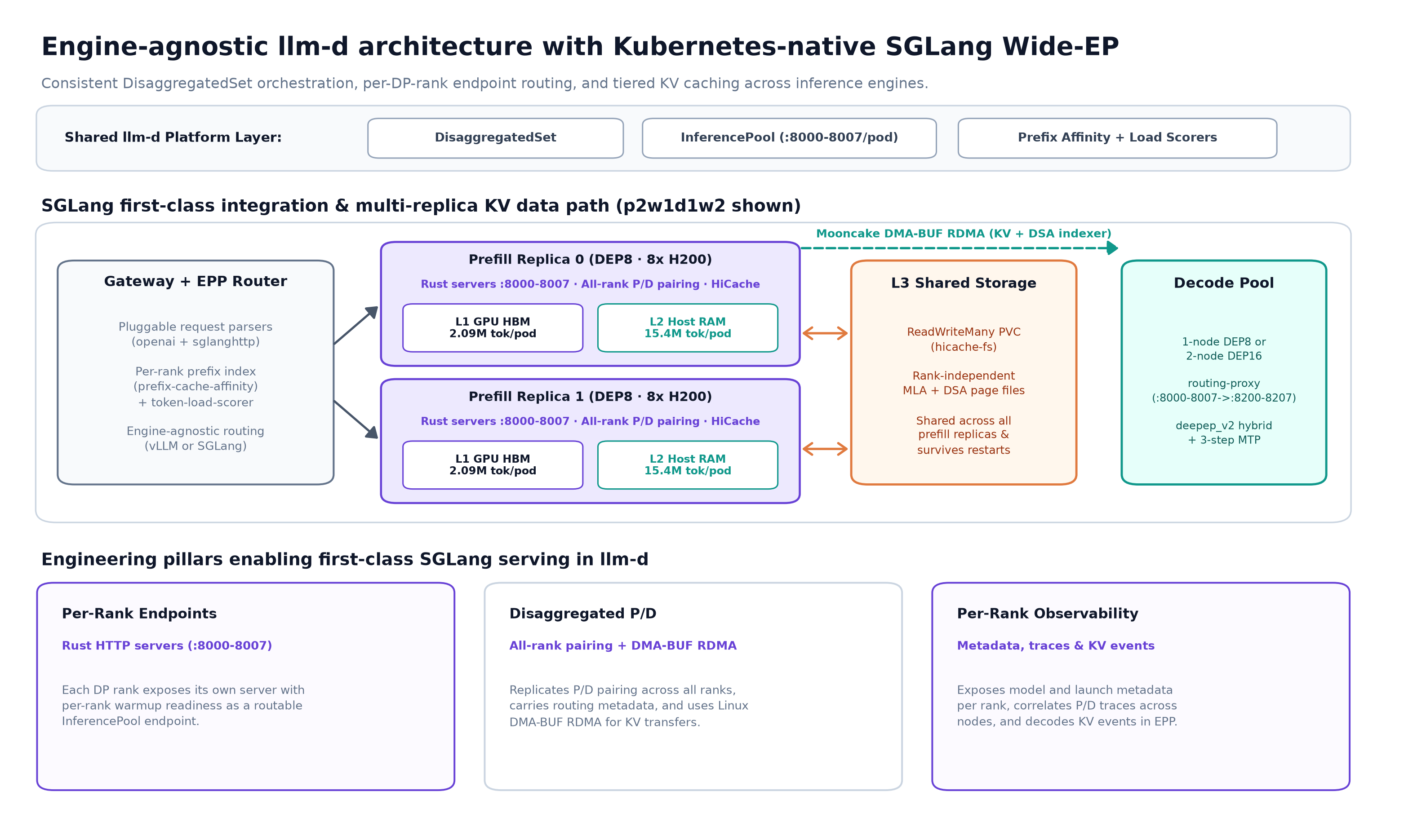
Figure 1: Engine-agnostic llm-d architecture with Kubernetes-native SGLang Wide-EP and Shared L3.
1. llm-d Architecture and Engine-Agnostic Design
A central design goal of llm-d is to give platform teams a unified Kubernetes control and routing layer regardless of which inference engine runs inside the serving containers. Rather than maintaining separate gateways, autoscalers, or cache-routing stacks per engine, llm-d separates cluster-level serving primitives from engine-specific execution, as shown in Figure 1:
- Declarative disaggregated orchestration: Multi-node prefill and decode pools run as native Kubernetes workloads through
DisaggregatedSet, with coordinated gang scheduling, rolling updates, and Dynamic Resource Allocation for GPUs and RDMA NICs. Scaling from a single-replica16-GPU deployment to multi-replica32- or64-GPU Wide-EP pools uses the same declarative overlays and operational lifecycle across engines. - Per-DP-rank
InferencePoolendpoint discovery: Rather than exposing a multi-GPU pod as one aggregated endpoint,llm-dregisters each attention-DP rank as its ownInferencePoolendpoint, following the design from the earlier GLM-5.2 post. This lets the router see and target each GPU's separate KV cache directly. - Pluggable
Endpoint Picker(EPP) routing pipeline: Fronted by Envoy and the Kubernetes Gateway API, theEPPinference router parses each request and tracks, per rank, which prefixes are cached and how many tokens are in flight. It selects the prefill rank holding the warm prefix and the least-loaded decode rank, while therouting-proxysidecar on the decode pod runs the prefill-to-decode handshake and dispatches both stages.
Because llm-d defines these primitives—per-DP-rank endpoints, separate prefill and decode scheduling profiles, and composable Kustomize components—at the platform layer, adding SGLang did not require a parallel routing stack or custom operator workflow. Once SGLang exposed the same per-rank endpoint and disaggregation contracts, users could choose SGLang as their serving backend under llm-d's Kubernetes control plane—getting out-of-the-box Wide-EP dispatch on RoCE networks and tiered KV-cache offloading with SGLang's Hierarchical Cache (HiCache).
2. First-Class SGLang Integration in llm-d
SGLang could already run GLM-5.2 Wide-EP as a standalone server, but integrating it into llm-d exposed a core boundary mismatch. In a Wide-EP deployment, MoE experts are shared across GPUs, while each attention-DP rank owns a separate KV cache. Because llm-d routes requests, tracks prefix locality, and pairs prefill with decode (P/D) at the per-DP-rank level, a single node-level endpoint is not enough. Every DP rank needs to act like an independent server—with its own port, its own P/D pairing handshake, and its own health and observability signals.
The goal of our engineering work was making SGLang's Wide-EP runtime fit cleanly into llm-d's Kubernetes control plane:
| Pain we hit | What we changed | What operators get |
|---|---|---|
| One node-level port hid eight separate KV caches behind a single endpoint. | Leveraged the embedded Rust HTTP server for each DP rank with per-rank warmup readiness. | Every DP rank across single- and multi-node pools is a routable InferencePool endpoint. |
P/D pairing only worked on rank 0; routing to any other rank failed during the handshake. | Replicated P/D pairing state across all rank listeners, carried routing metadata across OpenAI and native APIs, used standard Linux DMA-BUF RDMA for KV transfers, and added clean decode cancellation on prefill failure. | EPP can pair any prefill rank with any decode rank across nodes on standard GPU nodes. |
| Operators and routers lacked per-rank visibility into serving and cache hits. | Exposed model and launch metadata per rank, correlated P/D traces and logs across nodes, and added SGLang KV-event decoding in EPP. | Per-endpoint visibility in logs and traces, supporting zero-scrape approximate routing today and preparing exact KV-event tracking. |
3. Tiered KV-Cache Offloading and Multi-Replica Performance
With SGLang running natively behind llm-d's prefix-aware router, the remaining bottleneck for agentic serving is KV-cache capacity and survival. Using SGLang's HiCache on the prefill pool, we evaluate a three-tier KV-cache memory hierarchy on 8-GPU NVIDIA H200 nodes on GKE A3 Ultra with ConnectX-7 RoCE and a 9,000 GiB Google Cloud Managed Lustre volume:
L1— GPU HBM: Fast GPU-resident KV and DSA indexer pool holding261Ktokens per GPU, or2.09Mtokens per 8-GPU prefill pod—enough for roughly20–30repository-scale sessions.L2— Host RAM: Per-rank pinned host memory transferred over direct PCIe Gen5 DMA when pages evict fromHBM, expanding a single prefill pod to17.5ML1 + L2tokens at98.4 GiBper rank.L3— Shared Storage: SGLang's file backend on aReadWriteManyPersistentVolumeClaim—so any standard Kubernetes shared filesystem works without running a separate storage service—holding~163Mtokens across the9,000 GiBvolume, backed by a client-side metadata cache so each rank remembers pages it has already seen. Because GLM-5.2's MLA KV representation is identical across attention-DP ranks, page files carry no rank suffix—creating one deduplicated cache pool shared across every rank and prefill replica.
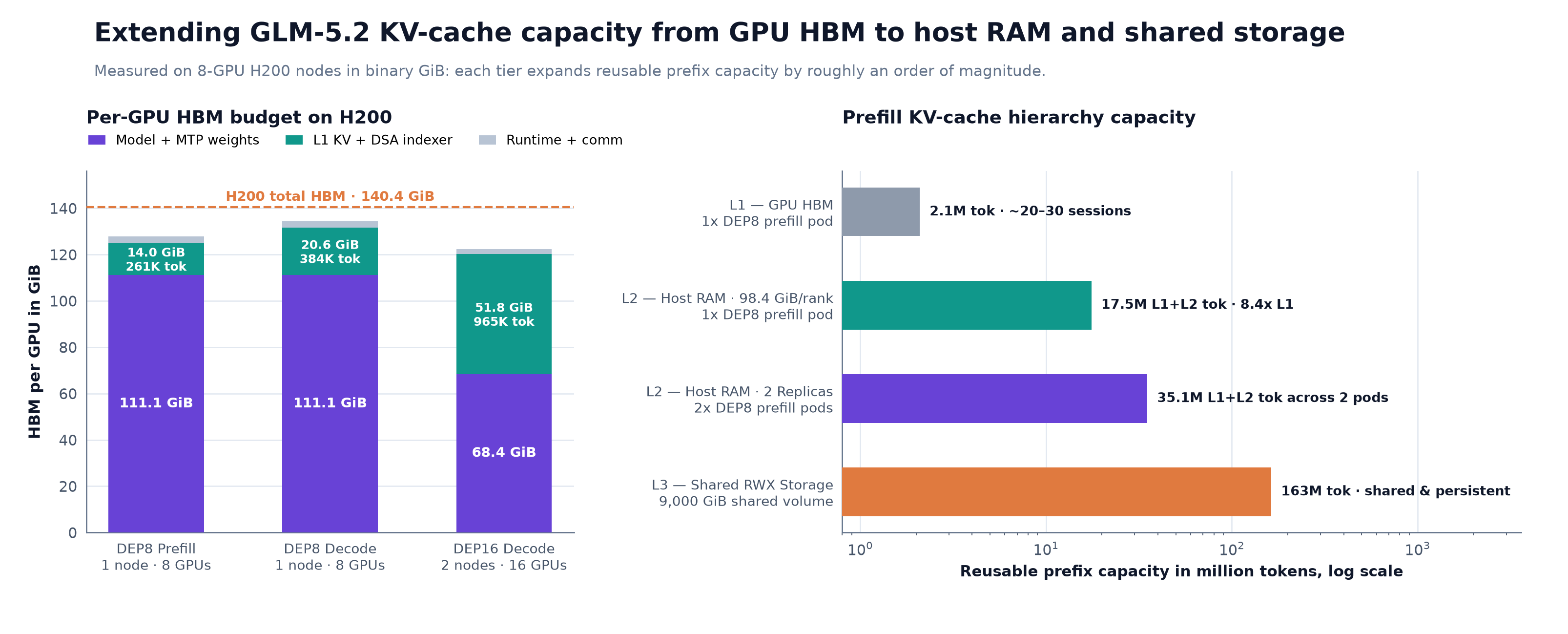
Figure 2: Extending GLM-5.2 KV-cache capacity from GPU HBM to host RAM and shared storage. All memory values are in binary GiB: an H200 exposes 140.4 GiB of HBM, and each DEP8 GPU holds one-eighth of the routed MoE experts alongside replicated MLA attention and EAGLE MTP weights for 111.1 GiB total.
Extending single-node memory with Host RAM on 16x H200
We measured how L2 host RAM and Shared L3 remote storage behave on the default 16-GPU single-replica 1P1D layout—one 8-GPU prefill pod paired with one 8-GPU decode pod—under the 900s AIPerf inferencex-agentx-mvp benchmark on the cc-traces-weka-062126 Claude Code trace corpus with a 142K context cap, swept from concurrency 16 to 128:
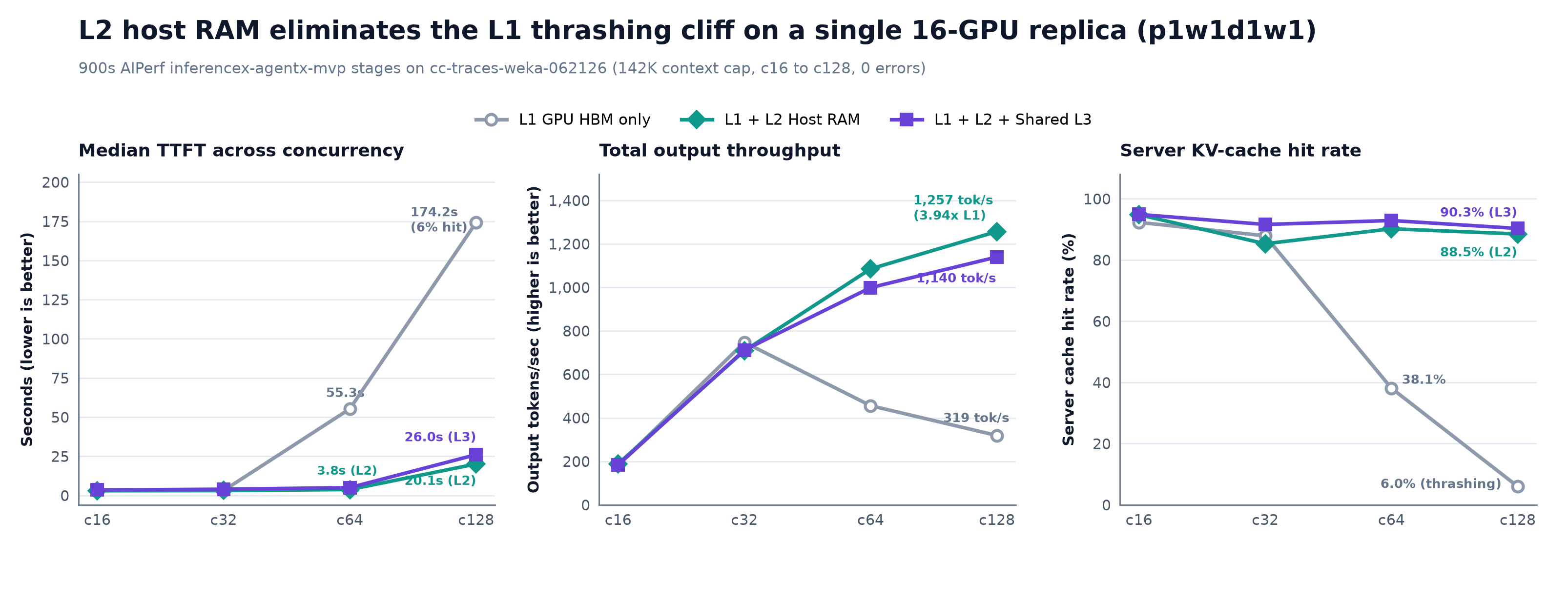
Figure 3: L2 host RAM eliminates the L1 thrashing cliff on a single 16-GPU replica.
Past concurrency 32, active sessions exceed the 2.09M-token HBM budget and evict one another, dropping the cache hit rate to 6.0% and pushing median TTFT to 174.2 s at concurrency 128. Offloading to L2 host RAM preserves 85%–95% cache reuse across the full sweep, cuts concurrency-128 median TTFT 8.7x, and raises output 3.94x—whereas our Shared L3 file configuration, which uses write_through backups for every new page and synchronous wait_complete prefetches, adds 14%–33% to median TTFT across concurrencies 16 to 128 and trims concurrency-128 output by ~9% on a single warm pod for no significant extra benefit.
Multi-replica Shared L3 on 32x H200
Shared L3 pays off across multi-replica failover, pod evictions, and cold restarts. To test this, we scale out to 32 H200 GPUs across two 8-GPU prefill pods and one 2-node 16-GPU decode pool. We measure sustained load at 64 and 128 concurrent sessions, a live failover test where we delete prefill-0 at t = 95 s across 24 active ~98K-token sessions so EPP moves its 11 sessions onto prefill-1, and a cold-replica recovery test that replays 16 ~92K-token sessions against a freshly restarted prefill pod:
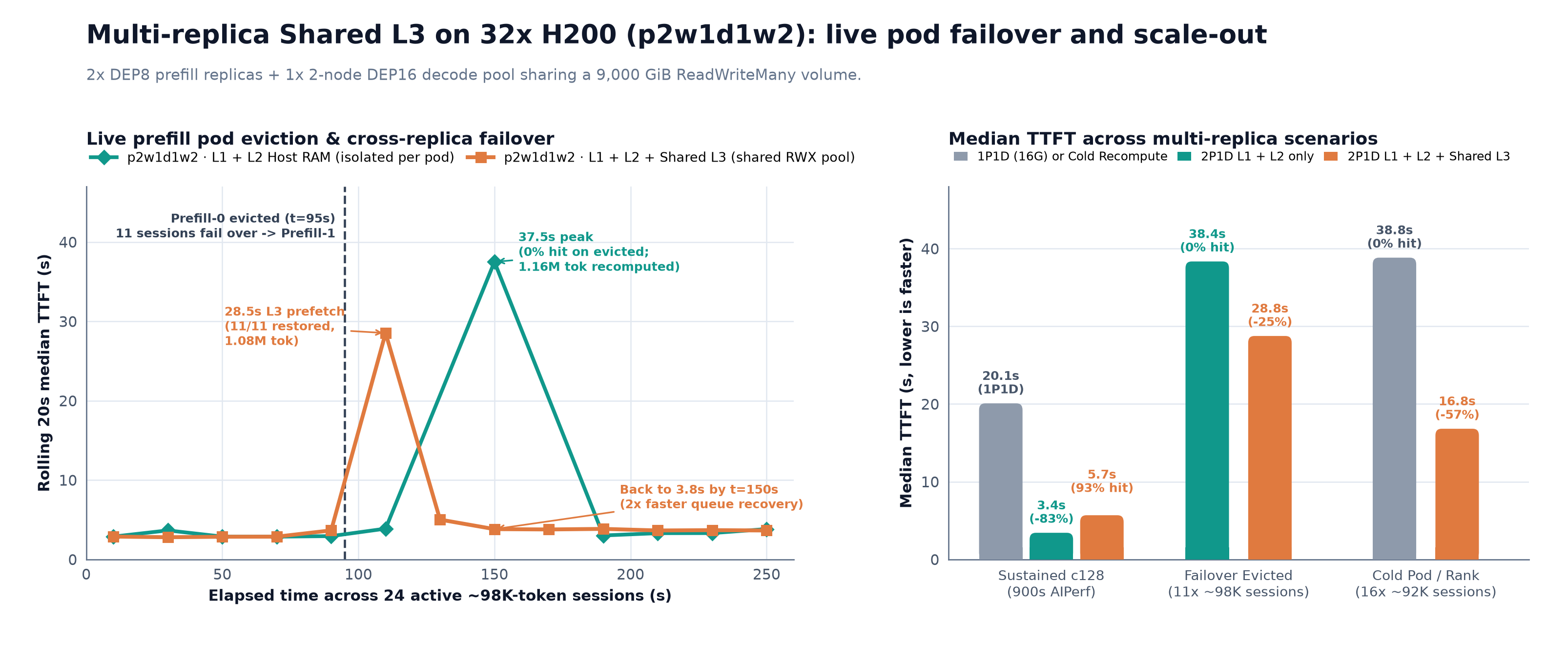
Figure 4: Multi-replica Shared L3 on 32x H200 (p2w1d1w2): live pod failover and scale-out.
Scaling out to two prefill replicas with a 2-node decode pool cuts concurrency-128 median TTFT 5.9x to 3.43 s at 1,903 tok/s. Under the same synchronous file configuration, Shared L3 adds steady-state overhead without failures—raising median TTFT by 26% at concurrency 64 and 66% at concurrency 128, while reducing output by <5% to 11%—but it restores 99.94% of failed-over prefix tokens from storage instead of recomputing them, cutting failover median TTFT by 25% from 38.4 s to 28.8 s and cold-replica recovery TTFT by 57% from 38.8 s to 16.8 s. Operators should therefore run L1 + L2 on steady single-replica pods and add Shared L3 when resilience to Spot preemptions, upgrades, or multi-replica failover matters; full deployment overlays are in guides/models/glm-5-2.
Running the Recipe
Deploying the SGLang GLM-5.2 stack on llm-d takes two steps—installing the standalone inference router with sglang.values.yaml, and applying one of the deployment overlays from guides/models/glm-5-2:
export REPO_ROOT=$(realpath $(git rev-parse --show-toplevel))
export GUIDE_NAME=glm-5-2
export NAMESPACE=llm-d-glm-5-2
source ${REPO_ROOT}/guides/env.sh

# 1. Deploy the engine-agnostic llm-d router with the SGLang Wide-EP configuration:
helm install ${GUIDE_NAME} \
  ${ROUTER_STANDALONE_CHART} \
  -f ${REPO_ROOT}/guides/recipes/router/base.values.yaml \
  -f ${REPO_ROOT}/guides/models/${GUIDE_NAME}/router/${GUIDE_NAME}.values.yaml \
  -f ${REPO_ROOT}/guides/models/${GUIDE_NAME}/router/sglang.values.yaml \
  -n ${NAMESPACE} --version ${ROUTER_CHART_VERSION}

# 2. Option A: 32-GPU multi-replica p2w1d1w2 with L1 + L2 host RAM (use deployments/p1w1d1w1 for the 16-GPU layout):
kubectl apply -n ${NAMESPACE} \
  -k ${REPO_ROOT}/guides/models/glm-5-2/modelserver/gpu/sglang/deployments/p2w1d1w2

# 2. Option B: 16-GPU p1w1d1w1 with Shared L3 (adds components/hicache-fs).
#    Needs a ReadWriteMany PVC named llm-d-kv-cache-storage. For multi-replica
#    Shared L3, add the same component to the p2w1d1w2 overlay.
kubectl apply -n ${NAMESPACE} \
  -k ${REPO_ROOT}/guides/models/glm-5-2/modelserver/gpu/sglang/deployments/benchmark/hicache-fs/p1w1d1w1
Conclusion
Bringing first-class SGLang serving to llm-d started with a simple constraint: supporting a second engine could not mean building a second platform. Contributors added per-rank Rust endpoints and replicated P/D pairing state in SGLang. As a result, llm-d now orchestrates and routes SGLang Wide-EP alongside vLLM through one Kubernetes stack.
On top of that integration, SGLang's HiCache keeps long-context agent sessions alive as traffic grows: run L1 + L2 host RAM on steady single-pod deployments, and add Shared L3 when pod evictions, cold starts, or multi-replica failover matter. Ready-to-run configurations are available in guides/models/glm-5-2.
What’s next
We are working to connect SGLang's disaggregated Rust preprocessing layer—sglang-processor, which is already shared across SGLang's router, standalone renderer, and per-rank Rust servers—with llm-d's router so prompts are rendered and tokenized once at ingress without router-to-worker token drift. Pairing that shared preprocessing with per-rank Rust metrics and KV-cache event streaming across L1, L2, and L3 will move SGLang routing in llm-d from approximate prefix tracking to exact, block-level cache awareness.