KV-Cache Offloading
KV-Cache offloading extends the effective cache capacity beyond GPU HBM by moving KV blocks to lower-cost tiers like CPU DRAM and shared storage.
llm-d works with any KV-cache connector compatible with vLLM or SGLang. Two integration patterns are supported:
- Native (vLLM
OffloadingConnector) — vLLM's built-in offloading path. Offloads to CPU RAM and, through multi-tier offloading, to secondary tiers such as a shared filesystem, an object store, or remote peers. - Out-of-tree connectors — third-party cache engines (e.g., LMCache, Mooncake, NVIDIA KVBM) that plug into the model server through its KV-cache connector API and own their own indexing, memory management, and storage.
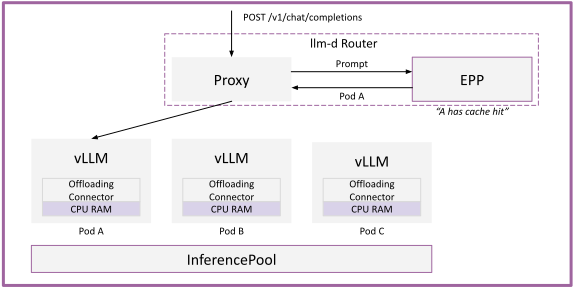
Pairs with the llm-d Router's cache-aware routing — the Router (specifically the EPP) picks replicas that can reuse cached blocks; offloading grows the cache each replica can hold.
Functionality
Transformer inference computes Key and Value tensors during prefill, then reuses them during decode. For long contexts or repeated prefixes (system prompts, agentic loops, multi-turn conversations), recomputing these tensors wastes significant GPU cycles. KV-Cache offloading addresses two scaling limitations:
-
Capacity — GPU HBM is limited (tens of GB per GPU). CPU RAM adds another order of magnitude, but storage can scale nearly infinitely.
-
Sharing — Local caches are isolated per model-server instance. Shared storage enables cross-node cache reuse, faster scale-up for new replicas, and persistence across pod restarts.
The offloading system generally operates asynchronously. Writes to lower tiers happen in the background without blocking inference. Reads from storage still require waiting, but loading cached blocks is typically faster than recomputing them—up to 16x faster for long prompts.
Offloading grows the KV working set each replica can hold, and with it the receptive field: how long a KV cache stays reusable after its request completes. Without offloading, a follow-on request that arrives after its prefix was evicted from HBM recomputes the prefill; with offloading, it loads the prefix back from a lower tier:
- Without KV offloading:
   ┌───────┐           ┌─────────┐            ┌───────────┐
   │user A │           │ user A  │            │  user A   │
   │  req  │           │   KV    │            │ follow-on │
   │       │           │ evicted │            │    req    │
   └───┬───┘           └────┬────┘            └─────┬─────┘
       │                    │                       │
───────●────────────────────●───────────────────────●───────▶ time
       │                    │                       │
       t                   t+a                     t+b
       │                    │                       │
       │◄───── KV live ────►│ ✗                     │
                                                    ▼
                                              ┌────────────┐
                                              │ RECOMPUTE  │
                                              │  PREFILL   │
                                              └────────────┘
- With KV offloading:
   ┌───────┐           ┌─────────┐            ┌───────────┐
   │user A │           │ user A  │            │  user A   │
   │  req  │           │   KV    │            │ follow-on │
   │       │           │ offload │            │    req    │
   └───┬───┘           └────┬────┘            └─────┬─────┘
       │                    │                       │
───────●────────────────────●───────────────────────●───────▶ time
       │                    │                       │
       t                   t+a                     t+b
       │                    │                       │
       │◄─────────────── KV live ──────────────────►│ ✓
                                                    ▼
                                              ┌────────────┐
                                              │ PULL FROM  │
                                              │  CPU RAM   │
                                              └────────────┘
Storage Tiers
Offloaded KV caches can live on several tiers, ordered by read/write latency: frequently accessed caches stay closest to the accelerator, while larger or colder caches move to slower, higher-capacity tiers. We recommend always enabling the HBM and CPU RAM tiers, and adding a filesystem tier when the working set grows beyond HBM + CPU RAM.
- CPU RAM — Low operational overhead and typically far larger than accelerator HBM, making it the default offload target. Loading from CPU RAM is faster than recomputing prefill in most cases, and asynchronous offload adds little overhead.
- Local disk — Increases capacity further, but is slower than CPU RAM. Suitable when the workload tolerates the added latency and local capacity is sufficient.
- Shared (remote) storage — Provides capacity independent of deployment size, KV-cache sharing across replicas, fast scale-up (new replicas reuse existing cache), and persistence across restarts and failures. Latency and throughput depend on the underlying system, so evaluate that the transfer cost does not outweigh the savings. Mature enterprise systems (for example CephFS, GCP Lustre, IBM Storage Scale, AWS EFS) integrate through standard POSIX file access.
- P2P sharing — Inference replicas can share caches in CPU memory over a peer-to-peer network, extending sharing without additional storage resources. See P2P KV-Cache Sharing.
Architecture
The two integration patterns map to distinct architectures.
Native (vLLM OffloadingConnector)
The native path lives entirely inside the vLLM stack. The OffloadingConnector supports two offloading specs:
CPUOffloadingSpec(default) — a single CPU RAM tier.TieringOffloadingSpec— multi-tier offloading: a CPU RAM primary tier plus one or more secondary tiers.
Only the CPU primary tier has direct GPU access. All transfers between GPU and a secondary tier are staged through the CPU tier:
┌─────────────────────────────────────────────────────────────────┐
│                            vLLM                                 │
├─────────────────────────────────────────────────────────────────┤
│                      V1 Connector API                           │
├─────────────────────────────────────────────────────────────────┤
│                    Offloading Connector                         │
└────────────────────────────────┬────────────────────────────────┘
                                 │  GPU DMA (async)
                                 ▼
┌─────────────────────────────────────────────────────────────────┐
│                   CPU RAM (primary tier)                        │
│             pinned host memory, LRU / ARC eviction              │
└──────────┬──────────────────────┬──────────────────────┬────────┘
           │                      │                      │
           ▼                      ▼                      ▼
   ┌──────────────┐       ┌──────────────┐       ┌──────────────┐
   │  Filesystem  │       │ Object Store │       │     P2P      │  ...
   │     (fs)     │       │    (obj)     │       │    (p2p)     │
   └──────────────┘       └──────────────┘       └──────────────┘
                         secondary tiers
| Tier | Latency | Capacity | Scope | Best For |
|---|---|---|---|---|
| CPU RAM | Low | ~250GB/GPU | Per-node | High-frequency reuse, preemption recovery |
| Shared filesystem / object store | Higher | TB+ | Cross-cluster | Cross-node sharing, persistence, massive scale |
| P2P | Network-bound | Peers' CPU RAM | Cross-node | Reusing blocks cached on other replicas, P/D disaggregation |
For the design and benchmarks, see the vLLM blog post Tiered KV Cache Offloading in vLLM.
CPU Tier
Each model server offloads to host CPU memory through its own native mechanism: vLLM uses the OffloadingConnector, and SGLang uses HiCache. Pods are configured with the connector enabled and increased CPU memory requests (e.g., 400 GB). Evicted KV-cache blocks move to host CPU memory instead of being discarded, extending the effective cache size with negligible overhead. The EPP maintains a global index of which blocks exist on which pods and tiers, adding a second prefix-cache-scorer plugin for CPU-tier blocks.
Tiered Offloading to Filesystem
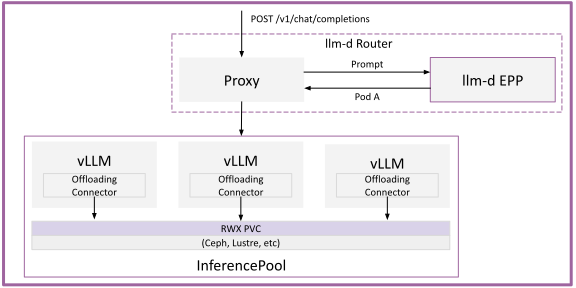
The OffloadingConnector also supports a multi-tier hierarchy: HBM → CPU RAM → filesystem. Configured with TieringOffloadingSpec and a secondary_tiers entry of type: fs, evicted blocks spill from CPU RAM to a ReadWriteMany PVC (backed by Lustre, CephFS, IBM Storage Scale, AWS EFS, or similar). Transfers between GPU and the filesystem are staged through CPU RAM; file I/O is asynchronous and parallelized across read/write threads.
Because the tier is shared, newly scaled pods read existing cache immediately and the cache persists across pod restarts; capacity is bounded only by the storage system. The connector does not evict data from the shared tier (see vLLM Multi-Tier Offloading).
Out-of-tree Connectors
Third-party connectors (see Other Connectors) adapt an external KV-cache engine to the model server through its KV-cache connector API. The same pattern is present across major serving stacks — vLLM's V1 Connector API, SGLang's HiCache, and TensorRT-LLM's KV Cache Connector API. Unlike the native path, the cache logic — indexing, memory management, tiering, eviction, and remote storage — lives in a separate engine, often a distinct process or service:
┌─────────────────────────────────────────────────────────────────┐
│               Model Server (vLLM / SGLang / TRT-LLM)            │
├─────────────────────────────────────────────────────────────────┤
│                     KV-Cache Connector API                      │
├─────────────────────────────────────────────────────────────────┤
│              Third-Party Connector (adapter)                    │
│      bridges lookup / store / load calls to the engine          │
└───────────────────────────────┬─────────────────────────────────┘
                                │  IPC / shared memory / RPC
                                ▼
┌─────────────────────────────────────────────────────────────────┐
│                   External KV-Cache Engine                      │
│  ┌──────────────┐  ┌──────────────┐  ┌──────────────┐           │
│  │ Cache Index  │  │ Memory Mgr   │  │ Controller   │           │
│  │ (token → KV) │  │ (pinned pool)│  │ (mgmt, evict)│           │
│  └──────────────┘  └──────────────┘  └──────────────┘           │
│  ┌───────────────────────────────────────────────────┐          │
│  │         Async Offload & Transfer Workers          │          │
│  └───────────────────────────────────────────────────┘          │
├────────────┬──────────────────┬─────────────────────────────────┤
│    CPU     │   Local Disk     │        Remote Backends          │
│   DRAM     │  (NVMe, etc.)    │   (object store, KV store, ...) │
└────────────┴──────────────────┴─────────────────────────────────┘
This pattern trades deployment complexity for flexibility: the external engine is independently versioned, can coordinate across multiple inference replicas, and typically supports a wider range of storage backends.
Components
vLLM Native CPU Offloading
vLLM's OffloadingConnector manages the GPU-to-CPU tier. It uses a hardware DMA engine for high-throughput transfers with minimal GPU core interference. The connector:
- Allocates pinned CPU memory for staging buffers
- Transfers KV blocks asynchronously using GPU DMA, avoiding interference with GPU compute cores.
- Uses a contiguous memory layout (introduced in vLLM 0.12.0) that groups all layers into single physical blocks, improving transfer throughput by 4-5x
CPU offloading requires no external infrastructure. The simplest way to enable it is via vLLM's dedicated top-level flags:
--kv-offloading-backend native --kv-offloading-size <size_in_GB>
Equivalent to passing --kv-transfer-config '{"kv_connector":"OffloadingConnector","kv_role":"kv_both",...}' directly — the top-level flags are a convenience wrapper around the connector JSON.
Serving models with mismatched attention head dimensions (e.g. Gemma 4) under KV offloading:
enabling the vLLM native OffloadingConnector disables vLLM's Hybrid KV Cache Manager (HMA). Most
models still run fine because their attention layers share one KV spec and collapse into a single
unified group: this includes sliding-window + full-attention models (e.g. gpt-oss-120b) and Mamba +
attention hybrids (e.g. Nemotron, whose attention layers are uniform and whose SSM state uses a separate
cache). Gemma 4 does not: its sliding-window and full-attention layers use different head
dimensions, so their KV specs cannot be unified and the server fails to start. To serve
such a model, add --no-disable-hybrid-kv-cache-manager to the vLLM args to keep HMA enabled.
vLLM Multi-Tier Offloading
TieringOffloadingSpec extends native offloading beyond CPU RAM. The CPU tier stays the primary tier, and blocks flow from it to one or more secondary tiers. Secondary tiers are looked up in the order they appear in secondary_tiers. On a hit in a secondary tier, the block is promoted back through CPU RAM to the GPU.
Built-in secondary tiers:
- Filesystem (
fs) — Stores KV blocks as files under a directory, typically a shared ReadWriteMany PVC. It works with any POSIX filesystem (CephFS, Lustre, IBM Storage Scale, AWS EFS, local NVMe). Multiple vLLM instances that share the directory reuse each other's cached prefixes, and the cache persists across pod restarts. I/O is asynchronous, with separate read and write thread pools. - Object store (
obj) — Stores KV blocks in an S3-compatible bucket through the NIXL OBJ backend. - P2P (
p2p) — Pulls KV blocks directly from other vLLM instances' CPU tiers over RDMA via NIXL. The router decides which peer to pull from; the same tier also implements prefill/decode (P/D) disaggregation. See P2P KV-Cache Sharing.
Custom tiers can be plugged in out-of-tree, with no vLLM changes, by implementing vLLM's SecondaryTierManager interface and setting module_path in the tier config.
The filesystem tier does not evict data. Storage capacity must be managed by the underlying storage system or an external controller. A reference implementation, the PVC Evictor, can automatically clean up old KV-cache files when storage thresholds are exceeded.
For the full configuration reference of each tier, see the vLLM KV Offloading Usage Guide.
The filesystem tier supersedes the standalone llm-d FS backend (llmd_fs_backend). llmd-fs-connector==0.23 (llm-d v0.8 / vLLM v0.23) was its final release. New deployments should use TieringOffloadingSpec with an fs tier.
MooncakeStoreConnector
Mooncake Store is a distributed KV cache system built on the Mooncake Transfer Engine. A centralized Mooncake Master manages object metadata, replica placement, leases, and eviction, while the Transfer Engine moves the underlying bytes between registered memory regions using RDMA or TCP. Together, they pool CPU DRAM across nodes—and optionally SSD/NVMe—into a shared cache tier without requiring a shared filesystem or PVC for the cache data path.
The MooncakeStoreConnector integrates this store with vLLM's V1 Connector API. It converts vLLM's content-addressed KV cache chunks into Mooncake object keys and maps their tensor data to the byte ranges stored and transferred by Mooncake. This allows multiple vLLM instances to retrieve and reuse cached prefixes, reducing redundant prefill computation.
- At the vLLM boundary, cache data is identified as content-addressed KV-cache blocks or chunks derived from vLLM block hashes.
- At the Mooncake boundary, each content-addressed key identifies a variable-length byte object. The connector maps that object to one or more registered memory ranges containing the corresponding K/V tensor data.
MooncakeStoreConnector (distributed cache offloading) is distinct from MooncakeConnector (point-to-point KV transfer for P/D disaggregation). They share the same Transfer Engine for RDMA data movement but serve different purposes and are configured independently. They can be composed via vLLM's MultiConnector when both P/D disaggregation and shared cache offloading are needed.
Architecture
The system consists of four components:
- Mooncake Master — Centralized metadata service managing keyed objects, their replicas and placement, leases, and eviction. It is unaware of vLLM's KV-cache block semantics. Deployment manifests are provided in
helpers/mooncake-master-store/. Required by both deployment modes. - Mooncake Client — A standalone process that allocates CPU DRAM and optionally SSD storage, registers those resources with the Master, and serves RDMA read/write requests from vLLM ranks. Only used in standalone-store mode. Deployment manifests are provided in
helpers/mooncake-client/. - Mooncake Transfer Engine — Byte-oriented data mover that transfers data between registered GPU or CPU memory regions and the distributed DRAM/SSD pool using RDMA or TCP.
- MooncakeStoreConnector (in each vLLM process) — Converts vLLM content-addressed cache chunks into Mooncake object keys and maps each object to one or more physical memory address-and-size ranges.
Two deployment modes are available:
| Mode | Description | global_segment_size | Components |
|---|---|---|---|
| Embedded | Each vLLM rank contributes CPU DRAM to the distributed pool in-process | > 0 (e.g., "80GB") | Master + vLLM |
| Standalone-store | External Mooncake Client process owns the CPU + SSD pool; vLLM ranks are pure requesters | 0 | Master + Client + vLLM |
Embedded mode is simpler to deploy — the DRAM pool scales automatically with the number of vLLM instances. Standalone-store mode decouples storage from compute and enables the SSD/NVMe tier by delegating resource ownership to the Mooncake Client. An example of when you might need the standalone mode as compared to the embedded mode, would be if the CPU being contributed to the distributed pool does not belong to the vLLM servers, and so you need some other process to manage the physical memory and disk.
Mooncake Master
The Mooncake Master handles block metadata, eviction, and snapshots. Key configuration parameters (set in configmap.yaml):
| Parameter | Default | Description |
|---|---|---|
eviction_high_watermark_ratio | 0.95 | Trigger eviction when pool is 95% full |
eviction_ratio | 0.05 | Evict 5% of pool capacity per cycle |
default_kv_lease_ttl | 5000 | Lease TTL in ms |
default_kv_soft_pin_ttl | 1800000 | Soft pin TTL in ms (30 min) |
enable_snapshot | true | Periodic snapshots to PVC for recovery |
snapshot_interval_seconds | 60 | Snapshot frequency |
The Master exposes gRPC (port 50051), HTTP metadata (port 8080), and Prometheus metrics (port 9003). See helpers/mooncake-master-store/ for deployment manifests.
Mooncake Client
The Mooncake Client (mooncake_client) is the process that owns physical memory and disk in the distributed pool. It is only used in standalone-store mode.
On startup, the Client allocates a CPU DRAM segment (--global_segment_size) and optionally opens a local SSD path for persistence (--enable_offload=true). It registers these resources with the Mooncake Master, making them available to the cluster.
These allocations are fixed for the lifetime of the process — the Client exposes no runtime API to resize segments, change SSD paths, or toggle offloading. Any change to resource sizing requires restarting the Client.
vLLM ranks never communicate with the Client directly — when a rank needs to store or load a block, it queries the Master for the block's location, and the Transfer Engine then moves the bytes peer-to-peer over RDMA between the rank and the Client's registered memory.
The two-tier storage within the Client works as follows:
- Writes land in CPU DRAM synchronously and are asynchronously persisted to SSD.
- Reads check DRAM first and fall through to SSD on a DRAM miss.
- Eviction is coordinated by the Master — when the DRAM pool hits the high watermark, the Master instructs the Client to spill blocks to SSD.
Decoupling storage from compute means the pool survives vLLM pod restarts, storage can be placed on nodes without GPUs (e.g., CPU-only nodes with large DRAM and NVMe), and the SSD tier is managed in one place per node rather than per GPU. See helpers/mooncake-client/ for deployment manifests.
Content-Addressable Storage and PYTHONHASHSEED
KV cache blocks are stored with content-addressable keys derived from vLLM's block hash mechanism. Python randomizes its hash() seed per process by default — if two vLLM instances compute different hashes for the same input tokens, they can never share cached blocks.
All vLLM instances sharing a Mooncake Store must set PYTHONHASHSEED to the same fixed value:
PYTHONHASHSEED=0 vllm serve ...
MooncakeStoreConnector — mooncake_config.json Reference
Each vLLM instance requires a Mooncake configuration file, pointed to by the MOONCAKE_CONFIG_PATH environment variable.
Embedded mode:
{
  "mode": "embedded",
  "metadata_server": "P2PHANDSHAKE",
  "master_server_address": "mooncake-master-store.mooncake.svc.cluster.local:50051",
  "global_segment_size": "80GB",
  "local_buffer_size": "4GB",
  "protocol": "rdma",
  "device_name": "",
  "enable_offload": false
}
Standalone-store mode:
{
  "mode": "standalone-store",
  "metadata_server": "P2PHANDSHAKE",
  "master_server_address": "mooncake-master-store.mooncake.svc.cluster.local:50051",
  "global_segment_size": 0,
  "local_buffer_size": "4GB",
  "protocol": "rdma",
  "device_name": "",
  "enable_offload": true
}
| Field | Description |
|---|---|
mode | "embedded" (in-process DRAM pool) or "standalone-store" (external client) |
metadata_server | "P2PHANDSHAKE" for direct peer-to-peer metadata exchange |
master_server_address | Mooncake Master gRPC endpoint (host:port) |
global_segment_size | CPU memory per GPU contributed to pool. Must be > 0 in embedded, 0 in standalone-store |
local_buffer_size | Private buffer per GPU for its own operations |
protocol | "rdma" (production) or "tcp" (fallback) |
device_name | RDMA device name (e.g., "mlx5_0"). Empty string for auto-discovery |
enable_offload | Enable SSD/NVMe staging. Must match mooncake_master and mooncake_client flags |
Environment Variables
| Variable | Default | Description |
|---|---|---|
MOONCAKE_CONFIG_PATH | (required) | Path to mooncake_config.json |
PYTHONHASHSEED | (random) | Must be set to same fixed value across all instances sharing the store |
For deployment recipes, see the Tiered Prefix Cache Guide (CONNECTOR=mooncake-store).
Other Connectors
Out-of-tree engines coexist with the native path through a common integration contract on the llm-d side:
- Serving-stack side — each engine is already connector-compatible with one or more of vLLM, SGLang (via HiCache), and TensorRT-LLM, so the model server drives lookups, stores, and loads through its standard KV-cache connector API.
- Scheduling side — connectors integrate with llm-d through KV-Events: cache mutation notifications that the KV-Cache Indexer consumes to maintain a global view of cache distribution, enabling prefix-aware routing regardless of which backend is in use.
llm-d's deployment guides cover LMCache and Mooncake Store today. The integration pattern is the same for KVBM and other connector-compatible engines — they work out-of-the-box on the serving-stack side.
For deployment recipes, see the Tiered Prefix Cache Guide.
Configuration
CPU Offloading (vLLM Native)
| Flag | Type | Default | Description |
|---|---|---|---|
--kv-offloading-backend | string | - | Set to native for vLLM's built-in CPU offloading |
--kv-offloading-size | integer | - | CPU offloading buffer size in GB (per vLLM instance, across all workers) |
For advanced use and older vLLM releases, the equivalent --kv-transfer-config JSON form is supported. See the vLLM offloading connector blog for details.
Multi-Tier Offloading (vLLM Native)
Multi-tier offloading is configured through --kv-transfer-config. Key kv_connector_extra_config fields:
| Field | Type | Default | Description |
|---|---|---|---|
spec_name | string | CPUOffloadingSpec | Set to TieringOffloadingSpec for multi-tier offloading |
cpu_bytes_to_use | integer | (required) | CPU tier size in bytes (per vLLM instance, across all workers) |
block_size | integer | GPU block size | Tokens per offloaded block (must be a multiple of the GPU block size) |
eviction_policy | string | lru | CPU tier eviction policy (lru or arc) |
secondary_tiers | list | [] | Ordered list of secondary tier configs, each with a type field (fs, obj, p2p) |
Filesystem tier (type: fs) fields:
| Field | Type | Default | Description |
|---|---|---|---|
root_dir | string | (required) | Base directory for KV-cache files |
n_read_threads | integer | 16 | I/O threads for loads |
n_write_threads | integer | 16 | I/O threads for stores |
For the full reference, including the object-store and P2P tiers, see the vLLM KV Offloading Usage Guide.
Examples
CPU Offloading with vLLM
args:
  - "--model=Qwen/Qwen3-32B"
  - "--tensor-parallel-size=2"
  - "--kv-offloading-backend=native"
  - "--kv-offloading-size=100"
Multi-Tier Offloading to a Shared Filesystem with vLLM
args:
  - "--model=Qwen/Qwen3-32B"
  - "--tensor-parallel-size=2"
  - "--kv-transfer-config"
  - |
    {
      "kv_connector": "OffloadingConnector",
      "kv_role": "kv_both",
      "kv_connector_extra_config": {
        "spec_name": "TieringOffloadingSpec",
        "cpu_bytes_to_use": 107374182400,
        "block_size": 256,
        "secondary_tiers": [
          {
            "type": "fs",
            "root_dir": "/mnt/files-storage",
            "n_read_threads": 16,
            "n_write_threads": 16
          }
        ]
      }
    }
volumeMounts:
  - name: files-storage
    mountPath: /mnt/files-storage
For an end-to-end deployment, see the Tiered Prefix Cache Guide with VARIANT=fs.
Distributed Offloading with MooncakeStoreConnector
At the vLLM server layer you might serve with the following configurations:
args:
  - "--model=Qwen/Qwen3-32B"
  - "--tensor-parallel-size=2"
  - "--kv-transfer-config"
  - '{"kv_connector":"MooncakeStoreConnector","kv_role":"kv_both"}'
env:
  - name: MOONCAKE_CONFIG_PATH
    value: /etc/mooncake/mooncake_config.json
  - name: PYTHONHASHSEED
    value: "0"
For the full mooncake_config.json reference, see MooncakeStoreConnector — mooncake_config.json Reference above.
Metrics
vLLM's native offloading exposes Prometheus metrics under the vllm:kv_offload_* prefix, for example:
- GPU ↔ CPU transfers —
vllm:kv_offload_load_bytes,vllm:kv_offload_store_bytes,vllm:kv_offload_load_time,vllm:kv_offload_store_time - CPU tier usage —
vllm:kv_offload_cpu_cache_usage_perc - Multi-tier offloading (
vllm:kv_offload_tiering_*) — secondary-tier hit rate (vllm:kv_offload_tiering_chunk_queries,vllm:kv_offload_tiering_chunk_hits), secondary-tier I/O (vllm:kv_offload_tiering_read_bytes,vllm:kv_offload_tiering_write_bytes), and promotion and cascade job failures
Performance Considerations
Choosing an implementation: Prefer each model server's native offloading path: the OffloadingConnector on vLLM and HiCache, its equivalent, on SGLang. Native offloading is low-overhead, needs no extra components, and enabling the CPU tier is appropriate in almost all deployments. Reach for an out-of-tree connector only when you need a capability the native path does not provide yet.
CPU offloading: Should always be enabled if CPU DRAM is larger than GPU HBM space. It has minimal overhead when the cache fits in HBM, and provides significant benefits when it doesn't—recovering preempted requests without recomputation and extending effective cache capacity with low latency.
Storage offloading: Best when cache working set exceeds single-node capacity, when cross-node sharing is valuable (repeated system prompts across replicas, agentic workflows), or when persistence across restarts matters. Storage offloading is most effective when the storage network is fast enough to allow low-latency loads and stores.
Storage selection: The filesystem tier works with any POSIX-compliant filesystem and is not tied to a specific vendor. Your choice trades off:
- Sharing scope — local media (e.g., NVMe SSDs) are per-node only; networked or distributed filesystems (e.g., NFS, CephFS, Lustre, IBM Storage Scale, Weka, cloud file services) enable cross-node reuse.
- Throughput and latency — depend on the underlying hardware, network, and filesystem configuration rather than the KV-cache layer; parallel and distributed filesystems generally scale best for large deployments.
Any POSIX filesystem is a candidate; the best choice for a given deployment depends on existing storage infrastructure, required scale, and latency targets.
Block size tuning: Larger block_size values (256-512 tokens) improve I/O efficiency but require longer matching prefixes for a cache hit. Match to your typical prefix lengths.
Distributed offloading (MooncakeStoreConnector): Best when cross-instance cache sharing is critical and RDMA networking is available. Eliminates the shared filesystem dependency and provides built-in eviction via the Mooncake Master. Embedded mode is recommended for most deployments; standalone-store mode adds complexity but enables the SSD tier and decouples storage from compute. Requires RDMA for production performance — TCP fallback is available but significantly slower.
Further Reading
- Tiered Prefix Cache Guide — Step-by-step deployment guides
- llm-d KV-Disaggregation Roadmaps — Planned features and improvements across offloading and KV-cache management
- P2P KV-Cache Sharing Guide — Sharing KV blocks between replicas through the P2P tier
- vLLM KV Offloading Usage Guide — Full configuration reference for native offloading and all secondary tiers
- Tiered KV Cache Offloading in vLLM — Design and benchmarks of multi-tier offloading
- vLLM KV Offloading Connector — Deep dive into vLLM's native offloading
- Multi-tier KV offloading RFC — The upstream tiering design
- LMCache and SGLang HiCache — Alternative offloading implementations
- Mooncake Store — Upstream Mooncake project and documentation
- vLLM MooncakeStoreConnector Usage Guide — vLLM-side configuration reference