Multi-Model Routing
Organizations often need to serve multiple large language models behind a single API endpoint. A chatbot application might use a Qwen model for conversational tasks, while a recommendation system uses DeepSeek for complex reasoning. Each base model may also have multiple Low-Rank Adaptation (LoRA) fine-tuned variants serving different use cases.
Traditional path-based routing cannot distinguish between these models when they share the same API path (/v1/chat/completions). The Inference Payload Processor (IPP) solves this by extracting the model name from the request body and routing to the appropriate InferencePool.
This capability requires IPP deployment. For simpler deployments serving a single model, see the Optimized Baseline guide instead.
Deploy
See the Multi-Model Routing guide for manifests and step-by-step deployment.
Architecture
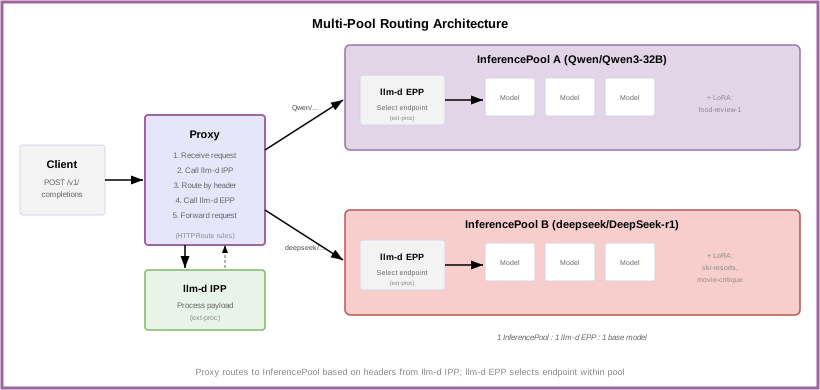
The setup creates multiple InferencePools, each serving a different base model:
- Each InferencePool serves one base model and its LoRA adapters.
- IPP extracts the model name from the request body and maps it to the base model.
- HTTPRoutes match on the
X-Gateway-Base-Model-Nameheader to route to the correct pool. - EPP selects the optimal endpoint within each pool.
During the standard request flow:
- Request arrives at the Proxy with
{"model": "food-review-1"}in the body - Proxy invokes IPP via ext-proc
- IPP looks up
food-review-1→ base modelQwen/Qwen3-32B - IPP sets header
X-Gateway-Base-Model-Name: Qwen/Qwen3-32B - Proxy matches HTTPRoute and routes to
qwen-pool - EPP selects endpoint, preserving the original model name
- Model server loads the
food-review-1LoRA adapter
Further Reading
See IPP Architecture for more details on the Inference Payload Processor.