Predicted Latency-Based Scheduling
llm-d's optimized baseline guide leverages load signals and prefix-cache affinity to schedule requests, combining the signals together with heuristics.
This path is for operators who want to adopt predicted latency-based scheduling - which uses an XGBoost model trained online - to make scheduling decisions. This strategy is useful when:
- Your workload has high variance in prompt and completion length, and queue depth alone is a poor proxy for true load.
- Your clients can express per-request latency SLOs (interactive vs. batch) and you want the gateway to enforce them.
- Static weight tuning between cache affinity and load has become fragile as traffic shifts.
Predicted latency is not a fit when the pool is heterogeneous — mixed GPU types, model variants (e.g. prefill vs decode), or serving configurations in the same pool will produce inaccurate predictions, because the predictor assumes a single pod shape.
Deploy
See the Predicted Latency guide for manifests and step-by-step deployment.
Architecture
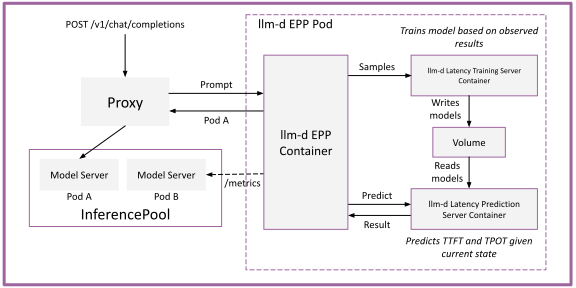
The setup deploys an EPP with the predicted latency sidecar containers:
- Training Server - trains the XGBoost model to predict TPOT and TTFT based on observed traffic
- Prediction Servers - predict TPOT and TTFT of the request based on current server state
During the standard request flow:
- Request arrives at the proxy, which forwards the request to the EPP
- EPP queries the prediction server
- EPP (using
latency-scorer) selects optimal endpoint based on the prediction - Proxy forwards request to the vLLM endpoint
- vLLM endpoint processes the request, returns response to proxy
- Proxy sends results to the training server, which uses samples to update the model
Further Reading
- Latency Predictor Architecture — plugin pipeline, ML model, scaling characteristics, metric reference.
- llm-d/llm-d-latency-predictor — source for the training and prediction server Python code.
- Predicted Latency-Based Scheduling for LLMs - Blog — design rationale and benchmark results.