P/D Disaggregation
LLM inference has two computationally distinct phases:
- Prefill processes the entire input prompt in a single forward pass - it is compute-bound, bottlenecked by the GPU flops available.
- Decode generates output tokens one at a time from the KV-cache - it is memory-bandwidth-bound, bottlenecked by how fast data moves from HBM to on-chip memory.
For long context workloads (10:1 ISL:OSL) and medium-to-large models, separating prefill and decode into separate instances enables:
- Improved throughput via specialization or prefill and decode
- Improved quality of service, as long context prefills will not block decode work
llm-d's EPP natively supports the concept of disaggregation, enabling composition with other scorers (e.g. prefix-aware routing).
important
NIXL supports TCP transfer, but high-bandwidth networking (IB, RoCE, EFA) is highly recommended for production usage.
Deploy
See the P/D Disaggregation guide for manifests and step-by-step deployment.
Architecture
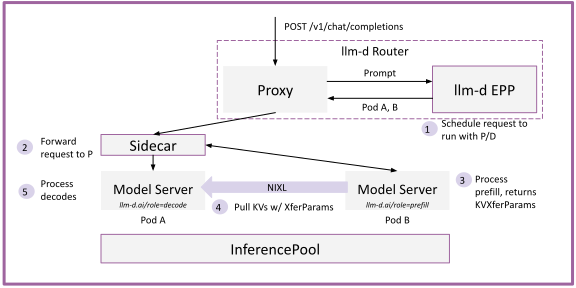
The setup creates 2 Deployments of vLLM (all are part of the same InferencePool):
- The prefill
Deploymentis 4 replicas of TP=1 vLLM - labeled withllm-d.ai/role=prefill. - The decode
Deploymentis 1 replica of TP=5 vLLM - labeled withllm-d.ai/role=decode. All these pods have a routing proxy sidecar.
During the standard request flow:
- Request arrives at the proxy, which forwards the request to the EPP
- EPP schedules the request with P/D disaggregation, using the labels to detect the decode and prefill variants
- Request is routed to the sidecar, which forwards the request to the prefill instance
- Prefill instance processes the prompt, returning metadata about how to retrieve the KV blocks
- Decode instance pulls the KVs over RDMA (IB, RoCE, EFA) with NIXL
- Decode instances processes the decodes
Further Reading
See PD Architecture for more details.