Endpoint Picker (EPP)
Functionality
The EPP is the "brains" of an llm-d deployment. It is focused on two key objectives:
-
Intelligent routing - selecting which model server pod within an InferencePool should process each inference request, using the internal state of model server pods (KV-cache utilization, prefix cache locality, request queue depth, and active request counts)
-
Fairness and prioritization - selecting which inference requests should run at any given time, enabling consolidation of multiple workloads with varying priorities onto a single set of Model Servers
The EPP is an extensible component that integrates with the proxy layer via Envoy's External Processing (ext-proc) protocol.
The project provides tools for automatic Envoy installation. However, if you install or
configure it yourself, please note that the only supported request_body_mode and response_body_mode
is FULL_DUPLEX_STREAMED
When a request arrives at the proxy, the proxy calls the EPP to select a backend endpoint, and the EPP returns the optimal pod address according to the Endpoint Picking Protocol.
Design
Request Flow
The following diagram shows the end-to-end lifecycle of a request as it flows through the EPP plugin pipeline:
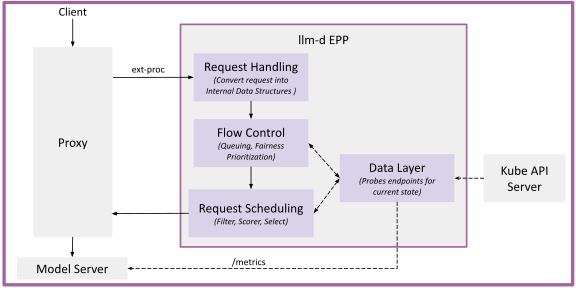
The steps are:
- Request arrival -- An inference request arrives at the proxy (Gateway).
- External processing -- The proxy invokes the EPP via the ext-proc protocol, passing the request headers and body to the EPP.
- Request handling -- Parses the request (from e.g. OpenAI format, vllm gRPC) into the internal request data structure.
- Flow control -- If enabled, queues requests and prioritizes and ensures fairness across different tenants within a priority, and holding requests when the pool is "saturated".
- Request Scheduling -- Selecting the optimal endpoint from the available InferencePool, which involves evaluating each request against a configured set of scheduling plugins, such as filters and scorers.
- Request Proxying -- The EPP returns the address of the selected endpoint to the proxy, which then forwards the request to the corresponding model server endpoint.
Asynchronously, the Data layer watches the Kubernetes API server for updates to relevant objects like InferencePools and Pods for endpoint discovery. It is also responsible for model servers metrics probing, and maintaining an internal state—such as a prefix cache tree—to inform the request processing components, flow control and request scheduling.
Components
The EPP is modular and pluggable, consisting of the following components:
Ext-Proc Server
The Ext-Proc Server protocol is very well defined & specific, deviations could cause the EPP to become unusable or unstable. Extension is ill-advised. The Ext-Proc is simply the standard interface by which the Proxy talks to the EPP.
Request Handler (Extensible)
The Request Handler is the first step of the request flow in the EPP. The key responsibility is to convert the user's request into the internal EPP data structure via the Parser plugin. The EPP provides out-of-the-box parsers for common formats like the OpenAI HTTP and vLLM gRPC.
In addition, users can write a custom parser for their own protocol. The rest of the functionality in EPP is agnostic to the original request protocol, enabling easy adaptation of the EPP to new request formats.
See Request Handling for more details on the design.
Flow Control (Extensible)
Flow control's primary purpose is to manage the admission, queuing, and dispatching of requests to prevent overloading backend model servers while ensuring fairness and priority. Specifically:
-
Admission Control & Throttling: Rather than allowing the inference pool to be overwhelmed, it intercepts incoming requests and holds them in an in-memory queue if saturation is reached. This is configurable via
SaturationDetectorplugins (such as the Concurrency plugin, which is based on active in-flight requests accounting per endpoint). -
Priority-Based Queuing: It categorizes traffic into "Priority Bands." Real-time, latency-sensitive tasks (like chat) are prioritized over batch background tasks (like summarization).
-
Resource Fairness: It prevents "noisy neighbor" scenarios by isolating traffic streams, ensuring a single flow (e.g., a user or application) cannot monopolize all available inference slots. Fairness is configurable via two pluggable policies: FairnessPolicy governs the distribution of dispatch opportunities among competing Flows within the same priority band (e.g., Round Robin), and OrderingPolicy plugins customize ordering of requests within a flow (e.g., FIFO, SLO-based).
-
Dynamic Dispatching: It monitors saturation to send requests to model servers only when they are ready to process them.
See Flow Control for more details on the design.
Request Scheduler (Extensible)
The scheduler acts as the core decision-making engine for intelligent request routing. It operates through a modular Filter → Score → Pick plugins pipeline orchestrated by a ProfileHandler plugin, allowing it to evaluate and select the most suitable model server endpoints for each incoming request.
By leveraging custom plugins at each stage—filtering out unavailable endpoints, scoring them based on metrics like "least-loaded" or "affinity," and picking final candidates—the EPP ensures high performance and efficient resource distribution across inference pools.
See Request Scheduling for more details on the design.
Data Layer (Extensible)
The Data Layer operates asynchronously, consuming and storing data from a variety of sources:
- Kube API Server about which pods are active in the InferencePool
- Model Servers about the current internal state (running requests, kv cache utilization)
- In-memory data structures, such as prefix cache trees for prefix-aware routing
- "Consultant" sidecars like the latency predictor, the kv-indexer or tokenizer for advanced routing
Other modules in the EPP consult the Data Layer during request processing.
See Data Layer for more details on the design.
How to Configure
The EPP is configured by passing an EndpointPickerConfig YAML to the binary via the --config-file or --config-text command-line arguments. This configuration defines the plugins, feature gates, and operational parameters that govern request handling, flow control, and scheduling.
The configuration is only read on startup. Any updates to the configuration require a restart of the EPP process to take effect.
For a detailed guide on the configuration schema, mental model, and examples, see the Configuration Guide.